
How to Read an Animal-Study Headline, and Why We Make No Mood Claim for SSAV
Question One: In Whom?
That 2013 paper, published in Nutritional Neuroscience, tested mice. Every other study we found that links Aloe Vera to serotonin or to behaviour also used mice, rats or cells in a lab dish. The first question for any headline is simply: in whom was this done?
If the answer is "in mice," the finding is a lead, not a result for people. The National Center for Complementary and Integrative Health calls basic research "the first step in any research." It saves its strongest words for clinical trials, which are "done with people" and give the clearest information about what is effective and safe "in humans."
Question Two: What Was Actually Measured?
A mood word in the title of a mouse study usually means something much narrower. In the 2013 paper, mice given Aloe Vera spent less time immobile in the forced swim and tail suspension tests, two screening tools used in rodents. A mouse cannot describe its mood; researchers record what it does, and the headline translates that behaviour into human words.
Look for the gap between what was measured and what the headline says. A 2025 study in rats, published in the Pakistan Journal of Pharmaceutical Sciences, measured an enzyme in the brain and concluded that the change would leave more tryptophan "for central serotonin synthesis." Serotonin itself is not reported as measured in the abstract. That is a reasonable hypothesis, but it sits one step away from a serotonin finding.
Question Three: Which Preparation, and What Dose?
"Aloe Vera" can mean the inner-leaf gel, the latex just under the rind, the whole leaf, a purified polysaccharide or a single compound such as aloe-emodin. Several recent rodent studies with mood-related titles tested aloe-emodin, an anthraquinone from the latex. Our guide to reading an Aloe Vera label explains why that difference matters, and our own SSAV (Super-Strength Aloe Vera) is anthraquinone-free, so those results do not describe it.
Dose needs the same care. Animal doses are given in milligrams per kilogram of body weight, and they do not carry over to people one to one. The FDA's standard dose-conversion table divides a mouse dose by 12.3, and a rat dose by 6.2, just to estimate a comparable starting dose for a first human trial. Even that conversion is about planning a safe first study. It says nothing about whether an effect will show up.
Question Four: Is There a Human Study, and How Big?
The last question is whether anyone has repeated the finding in people, and in how many. For Aloe Vera and serotonin the answer is no: we found no human study measuring what Aloe Vera does to serotonin, mood or behaviour. The human Aloe Vera trials closest to this topic looked at gut symptoms in people with IBS, not the brain, and the three we found ranged from 58 people randomised to 160 who completed the study.
Size and repetition matter because a single small study can land on a result by chance. NCCIH makes the same point about reviews that pool many studies: "When many studies come to the same conclusion, it helps us know that the results are reliable and valid."
The wider gut–brain field is in a similar place. A 2021 review in Gastroenterology concluded that "although animal studies have shown much promise, more progress is necessary before these findings can be translated" for patients. When a headline leaves that sentence out, add it back yourself. A quick checklist:
- In whom: people, animals or cells in a dish?
- What was measured: the thing in the headline, or something upstream of it?
- Which preparation, and what dose per kilogram?
- How many participants, and was there a comparison group?
Why SSAV Carries No Mood Claim
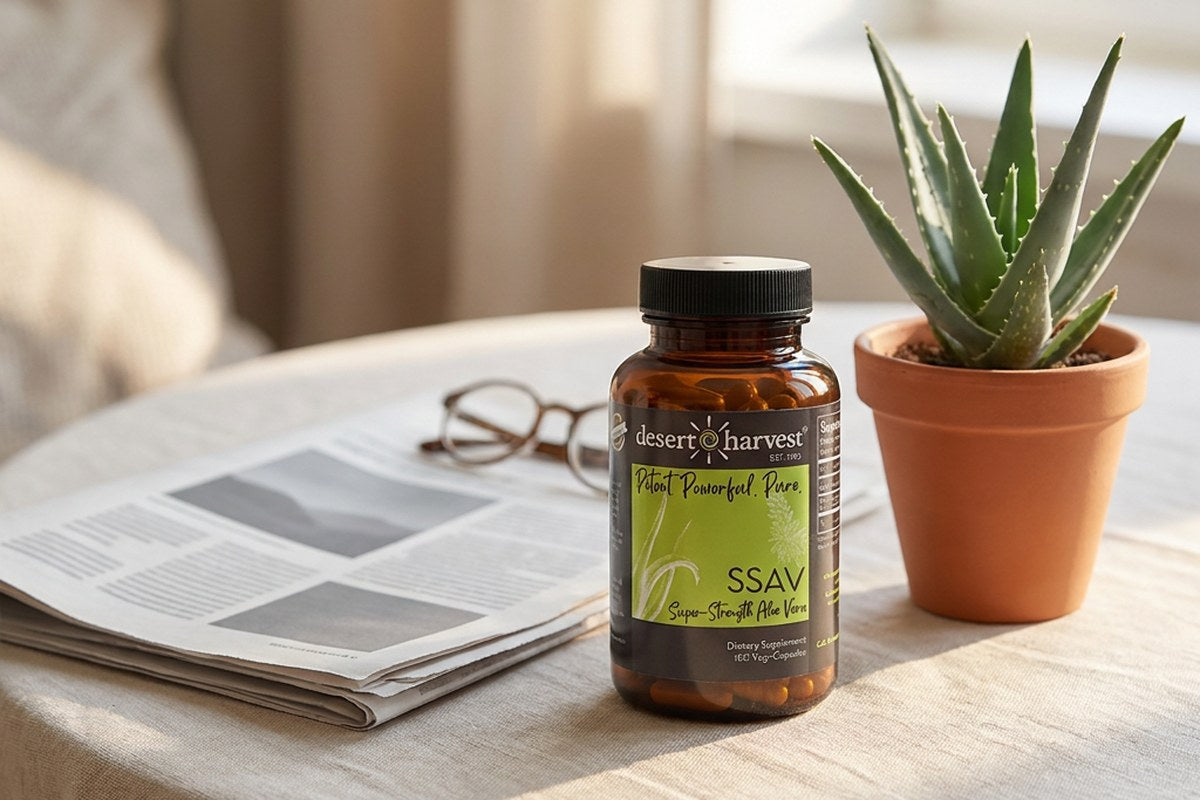
Put SSAV through that checklist and the answer is plain. No study of SSAV, and no human study of any Aloe Vera product, supports a mood, stress, sleep or serotonin benefit, so we do not make one, and you will not see "may support mood" on our pages. SSAV's lane is bladder comfort for people living with IC/BPS, where Desert Harvest is the only Aloe Vera supplement named in the International Painful Bladder Foundation's global IC/BPS guidelines. Our clinical studies page sets out that research.
We try to hold the bladder side to the same standard. The Interstitial Cystitis Association's supplements page still calls the scientific evidence for over-the-counter supplements in IC/BPS "inconclusive," and we think you should hear that from us too.
SSAV is a 200:1 concentrate, anthraquinone-free, made with a patented freeze-dry cold-process and third-party tested. If you take an SSRI or any other prescription medicine, talk to your prescriber before adding any supplement, and let your healthcare provider help you decide whether SSAV fits your plan.
These statements have not been evaluated by the Food and Drug Administration. This product is not intended to diagnose, treat, cure, or prevent any disease. This content is for informational purposes only and does not constitute medical advice. Always consult with a qualified healthcare provider before making changes to your health regimen.