


Why UTIs Spike in Summer: Heat, Travel and the Swimwear Question
Why do so many urinary tract infections seem to land in July and August? It is one of the most consistent patterns in urology, and it is not a coincidence of holiday schedules.
Research on the seasonality of urinary tract infections has repeatedly found the highest rates in the warmest months. Three separate factors converge in summer, and each one is easier to influence than most people assume.
Why Summer Is Peak Season
Heat changes the fluid you are holding
Sweating pulls water out faster than most people replace it, so urine becomes more concentrated and, critically, less frequent. Fewer trips to the bathroom means bacteria that reach the bladder have longer to settle before the next flush.
This is the least glamorous mechanism in urology and probably the most important. NIDDK describes urinary tract infections as among the most common infections in adults, and dilution is the body's simplest defense against them.
The behavior layer: travel, queues and delayed voiding
Road trips, festivals, unfamiliar restrooms, long flights. Almost everyone holds urine longer in summer than in winter, and almost nobody notices they are doing it.
Delayed voiding gives bacteria more contact time with the bladder wall. Combine it with lower fluid intake — because bathrooms are inconvenient — and you have the two behaviors that matter most, both moving in the wrong direction at once.
Damp swimwear and the perineal environment
A wet swimsuit worn for three hours keeps the perineal area warm and moist, which favors bacterial growth close to the urethra. The physics is unremarkable; the effect is real, and changing promptly is one of the few genuinely free interventions available.

What Is Actually Happening in a Recurrent Cycle
Where the bacteria come from
The large majority of uncomplicated urinary tract infections involve Escherichia coli originating from the gut. Their advantage is adhesion — fimbriae, tiny hair-like projections, latch onto the bladder wall and resist being washed away.
That is why recurrence is so common. The reservoir was never external, so the same strain can return again and again from the same place. Research indexed in PubMed has examined bacterial adhesion in detail for decades.
Why the cycle can outlast the antibiotic
Antibiotics remain the medical standard of care for an active infection, and nothing here substitutes for that conversation with your clinician. But clearing an episode is a different question from what happens over the following six months.
Repeated courses can disrupt the gut and vaginal microbiome that ordinarily competes with E. coli, and resistance patterns have shifted over time. The Urology Care Foundation is a clear, non-commercial place to read about recurrent infection alongside your doctor.
Tissue changes after menopause
Falling estrogen thins urogenital tissue and shifts the local microbiome away from its lactobacillus-dominant state. For women over 50, this is often the missing variable behind a pattern that seems to appear from nowhere.
Lowering Your Risk Through a Hot Summer
- Drink on a schedule. Four to eight ounces every 30 to 45 minutes; aim for pale straw urine, not clear and not dark.
- Empty completely, and do not postpone. Take the inconvenient bathroom.
- Void after intimacy. Long-standing advice, still sound.
- Change out of wet swimwear. Within minutes, not hours.
- Choose breathable cotton over synthetics on hot days.
- Ask your clinician about local estrogen if you are postmenopausal.
Where a botanical fits
Heather — Calluna vulgaris — has a long tradition of use for urinary wellness across northern Europe, and it has attracted modern laboratory interest. A study published in PubMed Central examined the in vitro activity of heather extracts against selected urinary tract pathogens. That is bench research, not a clinical outcome, and it should be read as such — but it is a reasonable reason the plant kept its reputation for several centuries.

The Desert Harvest Difference
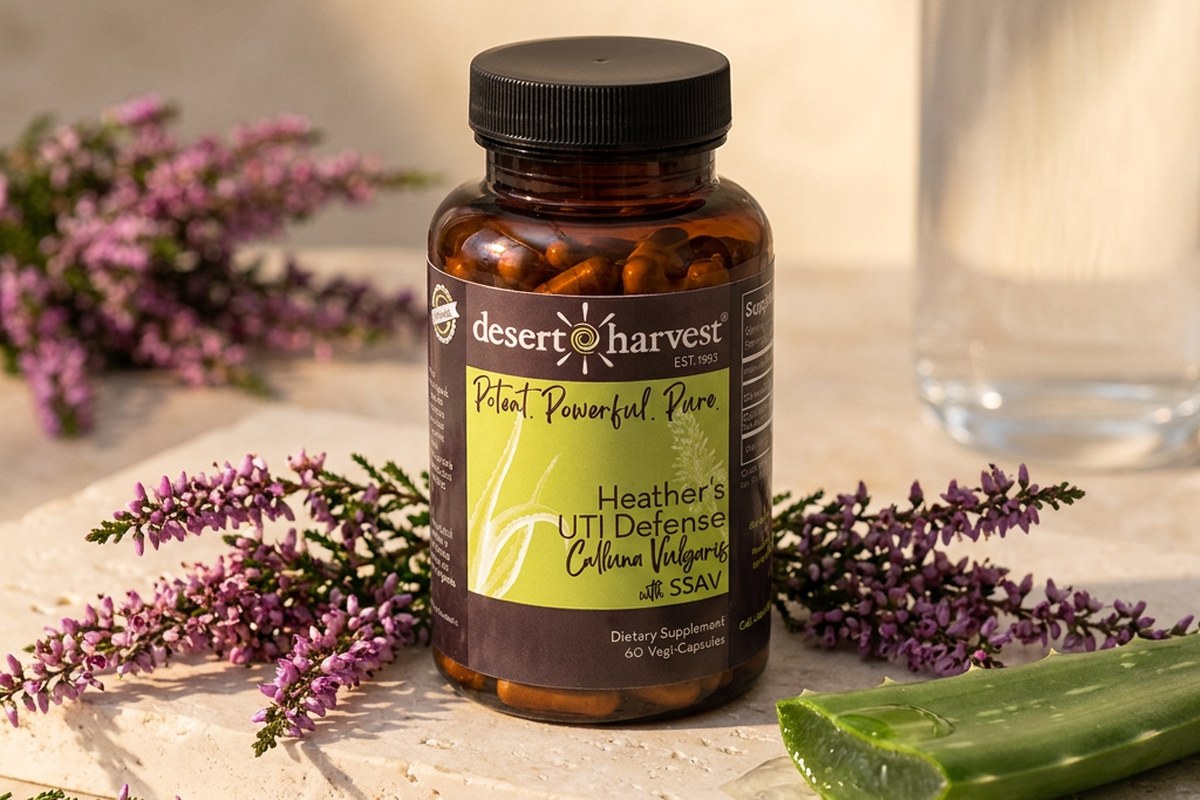
Heather's UTI Defense is built around that botanical: 300 mg of Calluna vulgaris, sourced from high-altitude growing regions, paired with a full 300 mg of SSAV (Super-Strength Aloe Vera) — the largest Aloe Vera dose in the Desert Harvest supplement range. One capsule daily with a full glass of liquid, 60 capsules per bottle.
The Aloe Vera is there because studies indicate it may support absorption of what travels with it. Everything is gluten-free, vegan, made in the USA, cGMP certified and third-party tested, with no fillers. "Heather’s UTI Defense is a new supplement that was recommended to me by my Urologist." — Shelley T., Verified Customer
Desert Harvest has served the bladder community since 1993 — see the rest of the bladder health range. We recommend consulting your provider before starting any new supplement, particularly if you have recurrent infections.
The Bottom Line
Summer does not make you more susceptible on its own. It changes three things at once — how concentrated your urine is, how long you wait to empty, and how long you stay damp — and those three changes stack. Adjust the habits and you have addressed most of what actually shifted.
Subscribe to Heather's UTI Defense and every subscription order ships free.
These statements have not been evaluated by the Food and Drug Administration. This product is not intended to diagnose, treat, cure, or prevent any disease. This content is for informational purposes only and does not constitute medical advice. Always consult with a qualified healthcare provider before making changes to your health regimen.