


Why There's Aloe in Our Quercetin (and Our Probiotic, and Almost Everything Else)
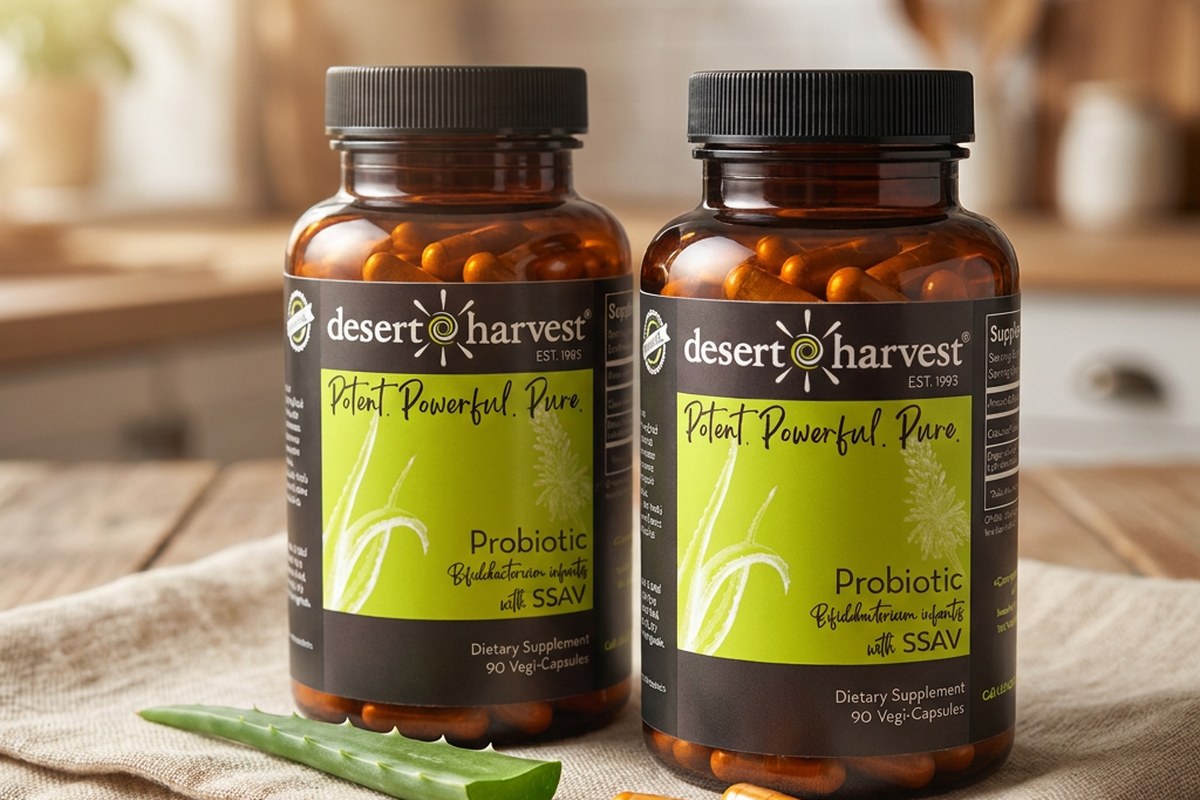
Turn over a bottle of Desert Harvest Quercetin and you will find something that does not obviously belong in a quercetin supplement: 100 mg of Aloe Vera. Turn over the Probiotic and there it is again — 200 mg, in a capsule that is otherwise one billion CFU of a single bacterial strain.
That is not a coincidence, and it is not filler. Aloe Vera has been in almost every formula this company has made since 1993, and there is a specific reason it keeps showing up next to other ingredients rather than standing alone. Understanding that reason will also teach you how to read any Aloe Vera label on the shelf — which turns out to be a much less straightforward skill than it sounds.
What "200:1" Actually Means
It is a concentration ratio, not a marketing number
When a label says 200:1, it means 200 parts of fresh Aloe Vera leaf were reduced down to one part of the finished powder. The 200 mg of SSAV (Super-Strength Aloe Vera) in a Desert Harvest Probiotic capsule started life as a great deal more raw plant than that number suggests.
This matters because Aloe Vera is roughly 99% water. A supplement that lists "Aloe Vera" without a ratio may be telling you almost nothing about how much plant material is actually in the capsule. Ratio is the number that carries information.

Which part of the leaf, and how it was dried
Aloe Vera is really two materials in one leaf. The inner gel is the clear filet most people picture. The outer rind and the latex layer just beneath it are a different substance entirely, carrying compounds called anthraquinones that behave as laxatives.
How a manufacturer separates and dries those layers decides what ends up in your capsule. Heat processing degrades the long-chain polysaccharides that make Aloe Vera interesting in the first place; a cold process protects them. We went deep on the anthraquinone question in Aloe Vera and Anthraquinones, and it is worth reading before you buy any Aloe Vera product.
Why Aloe Vera Travels With Other Nutrients
The absorption question
Here is the practical problem with a lot of supplements. Quercetin, for one, is famously poorly absorbed — the body simply does not take up much of what you swallow. That is true of a number of plant compounds people take every day.
Research has examined whether Aloe Vera’s polysaccharides may influence how other compounds move across the gut wall, and that literature is indexed in PubMed Central. Studies have looked at Aloe Vera alongside vitamins, minerals and plant compounds with this question in mind. It is an active area of investigation rather than a closed case — but it is the reason our formulator kept pairing them.
Acemannan, the compound that gets the attention
The long-chain polysaccharide most often named in Aloe Vera research is acemannan. It has been examined for its interaction with immune signaling and with mucosal tissue, and the body of published research on acemannan is substantial and still growing.
For a bladder-sensitive audience, the mucosal angle is the interesting one. The National Institute of Diabetes and Digestive and Kidney Diseases describes IC/BPS as a condition where the bladder lining is central to the story, which is part of why Aloe Vera entered this category at all.
How to Read an Aloe Vera Label

Four questions will separate a serious Aloe Vera ingredient from a decorative one:
- Is there a concentration ratio? No ratio, no information.
- Whole leaf or inner filet only, and how was it separated? Both can be excellent; vagueness cannot.
- Is the anthraquinone content addressed at all? A brand that has thought about it will say so.
- Was it heat-dried or cold-processed? This is the difference between intact polysaccharides and expensive dust.
If a label answers none of those, you are buying green powder on faith. Talk to your healthcare provider before starting any new supplement, particularly if you take medication that affects digestion.
The Desert Harvest Difference
Desert Harvest is the only Aloe Vera supplement named by name in the International Painful Bladder Foundation's global guidelines for IC/BPS — a distinction earned over three decades, not bought.
Our Aloe Vera is organic, whole-leaf, cold-processed by a patented freeze-dry method that keeps the polysaccharides intact while taking the anthraquinones out. It goes into our Quercetin at 100 mg per two-capsule serving and into our Probiotic at 200 mg per capsule at that 200:1 concentration. Everything is cGMP certified, third-party tested, gluten-free, vegan, and free of fillers and artificial ingredients. There is more on the plant science on our Aloe Vera science page.
The Bottom Line
The Aloe Vera you did not go looking for may be the most considered ingredient in the bottle. It is there because a poorly absorbed nutrient is a wasted nutrient, and because thirty-plus years of formulating for bladder-sensitive bodies taught this company that the delivery matters as much as the dose. Subscribe to Quercetin or the Probiotic and every subscription order ships free.
These statements have not been evaluated by the Food and Drug Administration. This product is not intended to diagnose, treat, cure, or prevent any disease. This content is for informational purposes only and does not constitute medical advice. Always consult with a qualified healthcare provider before making changes to your health regimen.