


One Strain, One Billion CFU: What a Single-Strain Probiotic Is Actually For
Walk down the probiotic aisle and the numbers escalate fast: 10 billion CFU, then 50 billion, then 100 billion, then 15 strains, then 30. Almost none of those numbers mean what the packaging implies they mean.
This is our Product of the Week piece, but it is mostly a shopping education. If you understand three things — what CFU counts, what a strain is, and why a bigger blend is not automatically a better one — you will be able to read any probiotic label in the shop, ours included, and decide for yourself. That is a more useful thing to own than a recommendation.
What a Probiotic Actually Is
CFU is a count, not a dose
CFU stands for colony-forming units — an estimate of how many live organisms are in the capsule at the time of testing. It is a headcount, not a potency measure, and the two get confused constantly.
A vitamin dose is a dose: 500 mg does more than 250 mg. Bacteria are not like that. They are living organisms that either establish themselves in an environment or do not, and doubling the number arriving at the door does not double the outcome. Beyond a threshold, the extra billions are mostly marketing.
Strain is the unit that matters
Lactobacillus is a genus. Lactobacillus rhamnosus is a species. Lactobacillus rhamnosus GG is a strain — and the strain is where research actually lives.
Two strains of the same species can behave completely differently in the gut. So a label that says only "Lactobacillus blend" is telling you roughly as much as a wine label that says "grapes". The National Institute of Diabetes and Digestive and Kidney Diseases is careful about this distinction when discussing digestive conditions, and so should you be.
The Community You Are Trying to Support
Bifidobacteria and the aging gut
Bifidobacterium species are among the very first to colonize the human gut in infancy — and across the microbiome literature collected in PubMed Central they tend to decline as we age. That downward drift is one of the more consistent findings in the field.
Bifidobacterium infantis is the strain most associated with that early-life gut community, and it has its own body of published research on PubMed covering digestive comfort and gut barrier function. Research suggests it may help support a settled digestive environment. It is not a fast-acting ingredient; consistency over months is the honest framing.
Why more strains is not automatically better
Here is the argument for restraint. Every additional strain is an additional variable, and additional variables are exactly what a sensitive body cannot afford.
If you take a thirty-strain blend and your gut becomes unhappy in week two, you have no way of knowing which of the thirty did it — or whether it was the blend at all. If you take one strain and something shifts, you have learned something real. For people with IC/BPS, whose reactions to new inputs are unpredictable and expensive, that difference is not academic. The Interstitial Cystitis Association has documented for years how idiosyncratic these sensitivities are.
How to Choose One — and How to Test It on Yourself

Read for four things
- A named strain, not just a genus and species.
- Storage requirements. Some strains need refrigeration; some are shelf-stable. Neither is better, but a shelf-stable one survives a Montana mailbox in August.
- What else is in the capsule. Fillers, dyes and flow agents are common and are the usual suspects when a "clean" supplement disagrees with someone.
- Timing guidance. Any probiotic should be spaced at least two hours from an antibiotic dose.
The one-variable rule
Start it alone. Not alongside a new multivitamin, not in the same week you change your diet. Give it a fair run — several weeks at minimum — and note what you notice.
Bloating and gas are worth watching, since the NIDDK's guidance on gas in the digestive tract makes clear how many ordinary things can drive them. Talk to your healthcare provider before starting a probiotic if you are immunocompromised, recovering from surgery, or on medication that affects your gut.
The Desert Harvest Difference
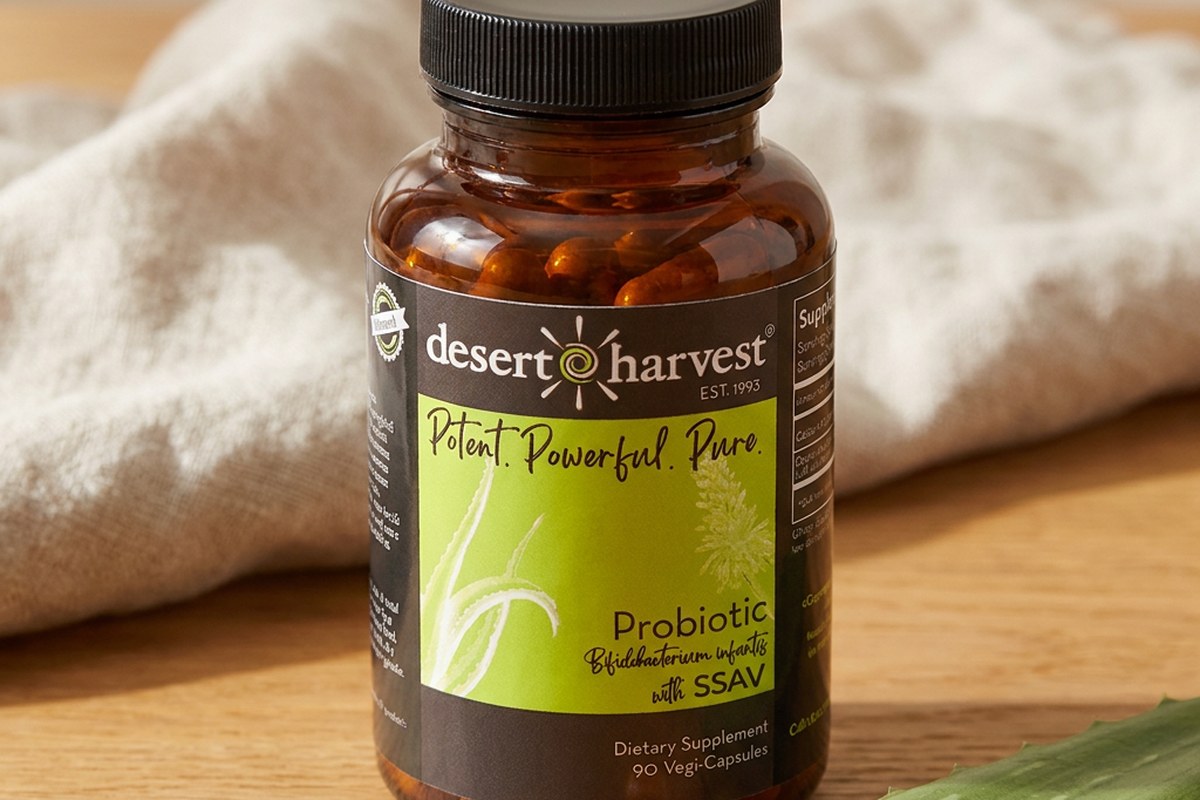
Our Probiotic is one capsule a day: 20 mg — one billion CFU — of Bifidobacterium infantis, plus 200 mg of organic whole-leaf Aloe Vera at a 200:1 concentration. One strain, one variable, no refrigeration.
The Aloe Vera is the part other probiotics do not have. It is the same organic cold-processed Aloe Vera that goes into everything we make, included here for absorption support and because it has been part of this company's formulating philosophy since 1993 — there is more on that on our Aloe Vera science page. No fillers, no artificial ingredients, gluten-free, bladder-friendly, cGMP certified and third-party tested. At $25 for 90 capsules, a daily capsule comes to about 28 cents.
"I have been using the probiotic capsules every day for about 12 years." — Patricia W., Verified Customer
Twelve years is the kind of endorsement no marketing budget buys. You can read 2,289+ more on our reviews page.
The Bottom Line
The probiotic aisle sells you numbers because numbers are easy to print. What actually matters is which strain, how few variables you are introducing at once, and whether you can stay consistent long enough to learn anything. One strain makes that possible. Subscribe to the Probiotic and every subscription order ships free.
These statements have not been evaluated by the Food and Drug Administration. This product is not intended to diagnose, treat, cure, or prevent any disease. This content is for informational purposes only and does not constitute medical advice. Always consult with a qualified healthcare provider before making changes to your health regimen.