


Why There's Aloe Vera in Your Multivitamin: The Absorption Story Nobody Explains
Read the label on a Desert Harvest magnesium capsule and you will find something that looks like a typo: 75 mg of Aloe Vera, sitting in a mineral supplement. It is in the vitamin C too, and the quercetin, and the multivitamin, and the mushrooms — every single formula.
That is deliberate, it has been that way since 1993, and the reasoning has almost nothing to do with what most people associate Aloe Vera with. This is the part of the label that never gets explained: what Aloe Vera actually is once you get past the sunburn bottle, and why a carefully processed form of it keeps showing up next to minerals and B vitamins.
Aloe Vera, Once You Get Past the Sunburn Gel
One plant, three very different materials
A cut Aloe Vera leaf yields three distinct things. There is the clear inner gel. There is the outer green rind. And in between sits a bitter yellow latex layer rich in anthraquinones — the compounds behind Aloe Vera’s old reputation as a harsh laxative.
Most of the disagreement about Aloe Vera as an ingestible comes down to which of those three ended up in the bottle. A whole-leaf extract that keeps the anthraquinones behaves completely differently from one where they have been removed. Our longer explainer on Aloe Vera science walks through the processing step by step.
The polysaccharide part
The compounds that draw research attention are long-chain sugars called polysaccharides, of which acemannan is the best known. Literature indexed in PubMed Central has examined these molecules for decades, and they are also why processing matters so much — polysaccharides are fragile, and heat-processed Aloe Vera is not the same material as cold-processed Aloe Vera.

The Absorption Question
How much you swallow is not how much you absorb
Bioavailability is the gap between the number on the label and the amount that actually reaches your bloodstream. It varies enormously by nutrient. Some minerals are absorbed at a modest fraction of the dose taken; the NIH Office of Dietary Supplements notes that magnesium absorption differs measurably between forms.
Vitamin and mineral labels almost never mention this. A bottle that lists 400 mg of something is telling you what went into the capsule, not what made it across the intestinal wall.
What has been studied
Human research has looked at whether Aloe Vera preparations change how much of a given nutrient reaches circulation, and studies indexed in PubMed have examined exactly this question for vitamins C and E. It is an active area rather than a settled one, and honest reporting means saying so: research suggests a carrier effect, and more human data would strengthen the picture.
There is a second, quieter reason too. Aloe Vera’s mucilaginous polysaccharides are gentle on the gut, which matters when your audience has spent years finding that ordinary supplements do not sit well.
Reading an Aloe Vera Label Without Guessing
Three things worth checking
- Which part of the leaf, and whether anthraquinones have been removed. "Decolorized" or "anthraquinone-free" is the phrase to look for.
- The concentration ratio. A 200:1 concentrate means 200 parts fresh leaf reduced to one part powder. Without a ratio, a milligram figure tells you very little.
- How it was dried. Freeze-dried cold processing preserves fragile polysaccharides in a way that heat processing does not.
Milligrams are relative
Because concentration ratios differ so widely between brands, 100 mg of one Aloe Vera powder can represent a completely different amount of plant material than 100 mg of another. Compare ratios first, milligrams second.
If you take prescription medication, ask your provider before adding any Aloe Vera-containing supplement to your routine — it is a short conversation and worth having.
The Desert Harvest Difference
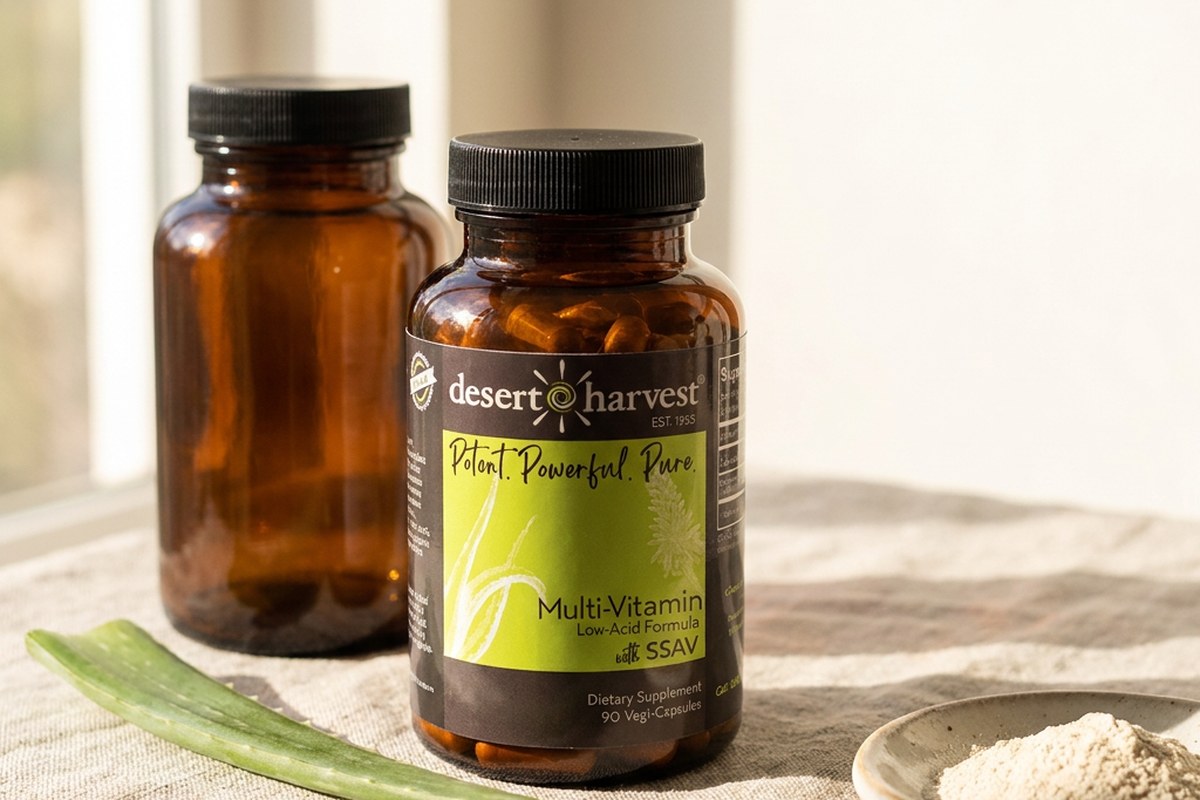
Every Desert Harvest formula is built on the same 200:1 SSAV (Super-Strength Aloe Vera) concentrate: whole-leaf, freeze-dried through a patented cold process, and anthraquinone-free. It is the only Aloe Vera supplement named by name in the International Painful Bladder Foundation's global IC/BPS guidelines, and it is documented across our clinical studies page.
The amounts are matched to each formula rather than sprinkled in: 50 mg in the Multi-Vitamin Low Acid, 75 mg in Magnesium, 100 mg in Quercetin, and 200 mg in the Probiotic. Same Aloe Vera, different jobs.
The Bottom Line
Aloe Vera in a multivitamin is not decoration and it is not marketing garnish. It is there as a carrier — a gentle, polysaccharide-rich base chosen so the nutrients beside it have the best chance of being absorbed, in a form that sensitive systems tolerate.
Next time you compare two supplements, look past the headline milligrams to the form, the ratio and the processing. That is where the real difference sits.
Subscribe to Magnesium and every subscription order ships free.
These statements have not been evaluated by the Food and Drug Administration. This product is not intended to diagnose, treat, cure, or prevent any disease. This content is for informational purposes only and does not constitute medical advice. Always consult with a qualified healthcare provider before making changes to your health regimen.